
Why pay you money only to take it back?
Because that's genuinely how the scheme is built. When the Winter Fuel Payment came back for almost all pensioners, the government chose not to means-test it up front — checking 10.9 million people's incomes before paying would have meant delays and mistakes. Instead, everyone qualifying gets paid in November or December, and the tax system quietly claws the money back from the roughly 2 million recipients whose incomes are high enough not to need it.
So if you earn over the line, the payment is best understood as an interest-free loan from yourself: it lands in your account before Christmas, and leaves again in instalments the following year. Annoying if you weren't expecting it — genuinely problematic if you've already spent it.
The cliff edge, with real numbers
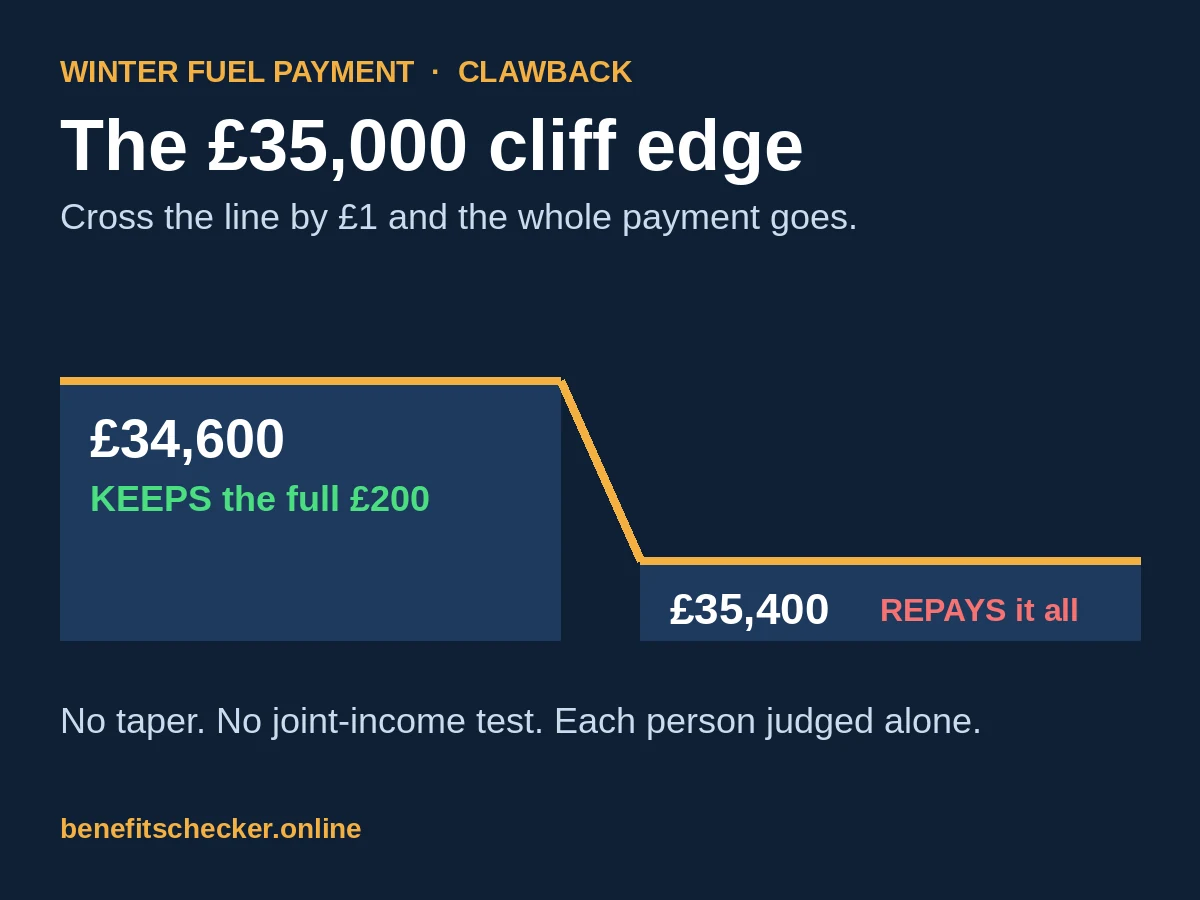
Most tax thresholds soften the blow with a taper. This one doesn't. Cross £35,000 by a single pound and the entire payment — £200 or £300 — is recovered.
- Margaret, income £34,600: keeps her £200 in full. Nothing to repay, nothing to file.
- David, income £35,400: receives his £200 in November, then repays all £200 through his tax code the following year. His £800 of income over the line cost him the whole payment.
- A couple, incomes £38,000 and £22,000: the higher earner repays their payment; the other keeps theirs. Joint income of £60,000 changes nothing — the test is always individual.
That last point trips up a lot of couples. Two pensioners in the same house can have opposite outcomes, and a household earning £70,000 between two people under the line keeps both payments, while a single person on £36,000 loses theirs.
Route one: PAYE — the shrinking tax code
Most pensioners are in PAYE through a private or workplace pension, and for them recovery is automatic. HMRC reduces your tax-free personal allowance in your tax code, and the payment comes back in monthly slices.
For the winter 2025/26 payment, collection started in April 2026 and works out at roughly £17 a month for a £200 payment. You don't apply, you don't send anything, and you can't hand the money back to DWP instead — plenty of people try, and DWP will simply tell you it's HMRC's job now. What you can do is check your tax code when it changes: if HMRC has the wrong income figure for you, the time to query it is when the new code arrives, not a year later.
Route two: Self Assessment — it's on your return
If you file a tax return, the recovery rides on that instead. For the 2025/26 payment, it belongs on the return you're completing now:
- Filing online: HMRC fills in the Winter Fuel Payment you received where it can match it. Check the figure is there and correct — if it's missing, adding it is your responsibility, not theirs.
- Filing on paper: nothing is pre-filled. You must enter the payment yourself, and the paper deadline is 31 October 2026.
- The bill: if your 2025/26 income was over £35,000, the payment is added to your Self Assessment bill, due 31 January 2027.
The trap is assuming that because the payment was automatic, the tax side is automatic too. For Self Assessment filers it isn't — leave it off the return and you've under-declared, which is a worse conversation than paying it.
January 2027: the double-collection squeeze
One consequence almost nobody has spotted yet. The recovery cycles for two winters overlap. From January 2027, Self Assessment filers settle the 2025/26 clawback in their bill — while PAYE pensioners are still partway through repaying 2025/26 monthly, just as the machinery starts on the 2026/27 payment (recovered from April 2027 for PAYE, or on the 2026/27 return for SA filers).
If you received £200 in both winters and earn over £35,000 in both years, there are months in 2027 where the combined collection runs at roughly £30 to £33 a month. It's not a penalty and it's not a mistake — it's two separate recoveries landing at once. But if the first you hear of it is a changed tax code, it will certainly feel like one.
"Can I just opt out?" — mostly, no
There was an opt-out, and for England, Wales and Northern Ireland it closed in September 2026. If you didn't take it and your income is over the line, the sequence is now fixed: receive the 2026/27 payment this November or December, repay it through tax afterwards. The opt-out reopens for winter 2027/28 — the window opens on 21 December 2026 — worth a diary note if you'd rather skip the loop next year.
Scotland runs on its own clock. The Pension Age Winter Heating Payment has the same £35,000 recovery, but its opt-out stays open until midday on 19 October 2026. If that's you, our Scotland guide covers the detail while there's still time.
Close to £35,000? Worth a careful look
HMRC works from your total income for the tax year — the figure your tax code or return is built on. For people hovering just over the line, ordinary tax planning can change that figure: pension contributions and Gift Aid reduce total income for many taxpayers, and a one-off item (a lump sum taken in the "wrong" year, say) can be the whole difference between keeping £300 and keeping nothing. We're not tax advisers and this isn't advice — but if you're within a few hundred pounds of the line, an hour with one could be worth exactly £200 or £300.
And the scam version is already circulating
HMRC has logged tens of thousands of referrals for Winter Fuel Payment scams — texts and calls claiming your payment is "held" or that you must "confirm details to avoid repayment". Real recovery needs no confirmation, no bank details and no phone call from you. If a message asks for any of those, it's the fraud, not the clawback.
Sources & accuracy: the £35,000 recovery rule, who it applies to and how HMRC collects it per GOV.UK — Winter Fuel Payment (winter 2026 to 2027). Self Assessment deadlines per HMRC's published filing calendar (paper 31 October, online and payment 31 January). Monthly collection figures are worked examples based on a £200 payment spread across a tax year — your tax code is HMRC's exact word, not ours. We are an independent guide, not DWP or HMRC, and nothing here is personal tax advice.
Last checked: October 2026